 Fraunhofer Group for Microelectronics in cooperation with the Leibniz institutes IHP and FBH
Sold-out debut: FIRST by FMD Strikes a Chord with the Microelectronics Industry
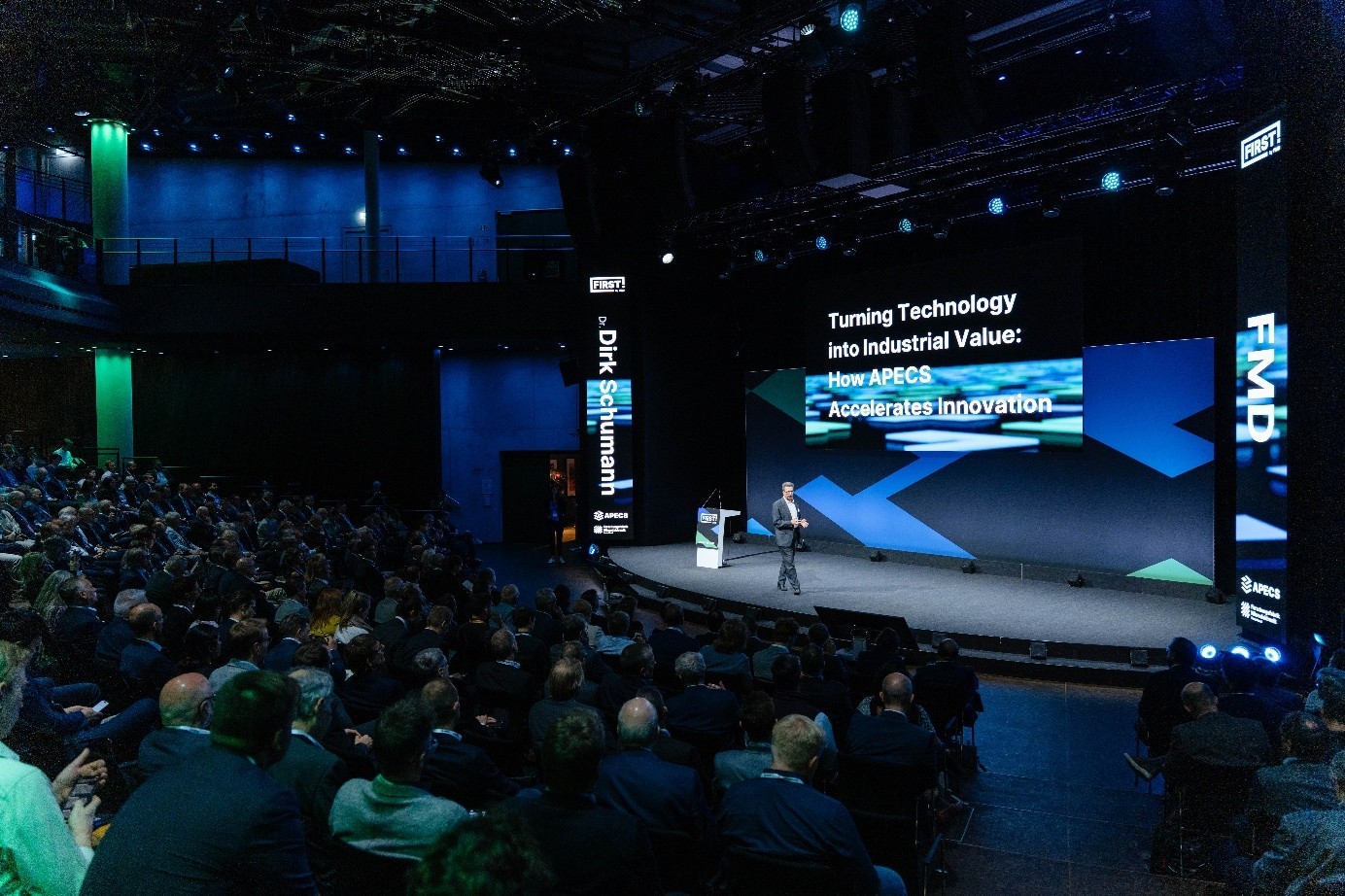
More than 500 participants from over 200 companies, including ASML, Bosch, Intel, Infineon, GlobalFoundries, and TRUMPF, gathered in Berlin on September 30 and October 1, 2026, for the inaugural edition of FIRST by FMD. The new European forum focused on key trends in microelectronics brought together decision-makers from industry, policy, and research who are actively shaping the future of microelectronics in Europe. A central focus was the APECS pilot line, a key building block of the EU Chips Act.
Europe has strong capabilities in research, technology, equipment, materials, and industrial applications, but holds only about 10 percent of the global semiconductor market. The EU Chips Act aims to double this share to 20 percent. It is clear that this ambitious goal poses a challenge, especially in light of growing international competition, technological dependencies, and increasing time pressure to bring new technologies to market.
For this reason, FIRST by FMD, organized by the Research Fab Microelectronics Germany (FMD) brought together key players in the European microelectronics sector.
The right people for Europe's future, all in one place
“FIRST brings together technology, research, the public sector, capital, and industry,” explains Ole Gerkensmeyer, Chief Strategy Officer at Nexperia. “Bringing these different perspectives together is very important for industrialization. […] The challenge is not innovation itself, but bringing innovation into mass production. FIRST brings together the stakeholders who need to work on exactly this transition.”
The composition of the participants at FIRST reflected the breadth and diversity of the European microelectronics ecosystem: from semiconductor manufacturers to equipment and technology providers, EDA, test, and measurement companies, as well as leading industrial users and system providers, all perspectives were represented. There were also interesting contributions from young deep-tech and startup companies, as well as from other stakeholders in research, politics, and the European semiconductor ecosystem.
From industry needs to industry solutions
FIRST highlighted specific projects, technological challenges, and successful collaborations, demonstrating how FMD is already helping to bring innovations to market more quickly through its services and the APECS pilot line.
“The success of FMD and the cooperation between FMD, industry, and research organizations essentially depend on close collaboration between these different entities,” says Thomas Rettich, Head of Scientific Coordination at TRUMPF. He goes on to explain: “It is an open innovation system. It depends on cooperation and on projects that are defined jointly. But it also needs an ecosystem […]. Within such an ecosystem, research organizations and industry can come together and develop technologies for industrial application. We hope to be part of that.”
From Advanced Packaging to Photonics: Mastering Challenges
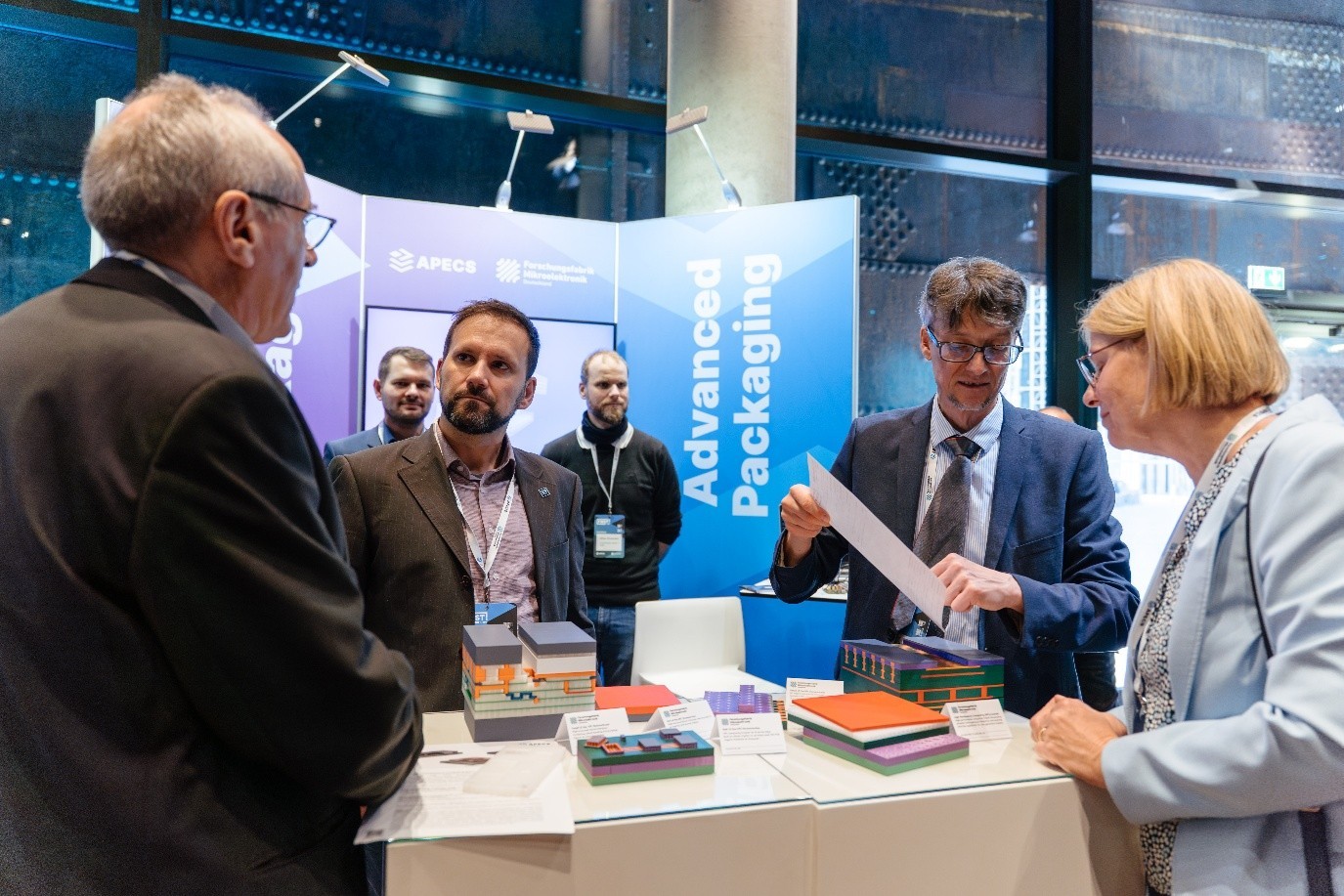
FIRST’s strategic perspective was complemented by concrete technological insights: At Demo Street, as well as during the Innovation Deep Dives and Technology Insights sessions, participants gained insights into current developments, potential applications, and the next steps toward industrialization. The spectrum ranged from advanced packaging, heterogeneous integration, chiplet architectures, and 2.5D/3D integration, through MEMS, sensor technology, photonics, RF, and power electronics, to System Technology Co-Optimization (STCO), Quasi-Monolithic Integration (QMI), and design, test, and manufacturing infrastructures. A special focus was placed on the APECS pilot line. Demonstrators illustrated how different design, process, and integration competencies work together for the next generation of microelectronic systems.
Access to technology is becoming a strategic factor
Discussions at FIRST made it clear, however, that technological excellence alone is not enough to bring innovations to market. Companies need access to expertise, specialized technologies, and suitable development and process infrastructures. This is where the APECS pilot line comes in; with total funding of 730 million euros, it is the largest project ever coordinated by the Fraunhofer-Gesellschaft.
“APECS adds complementary capabilities across Europe – from materials, front-end and back-end processing to advanced packaging and testing; from devices and components to modules and, ultimately, complete system applications,” explains Dr. Dirk Schumann, APECS project manager. “This is more than just connecting individual pilot facilities. It creates a continuous innovation path across borders and across technological domains. For industry, that means access not only to a single technology or process step, but to the complementary capabilities required to move an idea through the entire value chain.”
This was also underscored from the industry’s perspective: “We need to bring Europe’s extremely strong research infrastructure together with industry, so that RTOs are not only part of R&D, but also become part of manufacturing,” says Volker Herbig, Vice President of the Microsystems & Photonics Business Unit at X-FAB. “This is the missing link, and we can address it with APECS at the European level and with FMD in Germany.”
FMD as a unifying element of microelectronics expertise in germany
The importance of cross-sector collaboration was also evident from a political and strategic perspective. In his speech, Prof. Holger Hanselka, President of the Fraunhofer-Gesellschaft, emphasized the importance of European collaboration and close ties between research and industry. He stressed that it is crucial to combine existing strengths and jointly translate them into scalable technologies. “At FIRST, we bring together research, industry, ministries, and the European Commission [around] the same goals, the same direction, and the same timeline.”
Kilian Gross of the European Commission also highlighted the importance of the FMD as a unifying element for microelectronics expertise in Germany and Europe, while Dr. Alexandra-Gwyn Paetz of the Federal Ministry of Research, Technology, and Space (BMFTR) referred to the High-Tech Agenda Germany as an action plan with long-term priorities and milestones for competitiveness and resilience. For microelectronics, this includes, among other things, strengthening chip design in Germany and expanding European cooperation on strategic technological priorities.
First was launched and will continue in 2027
The debut of FIRST demonstrated that there is a significant need for strategic dialogue within the microelectronics industry. The format’s particular strength lay in bringing together diverse perspectives. Strategic issues were addressed alongside specific industrial requirements; technological developments were linked to applications; and research was connected to companies that translate these technologies into products and processes.
About FMD and APECS
FMD, a collaboration among 13 Fraunhofer institutes and the Leibniz institutes FBH and IHP, is the central point of contact for all questions related to micro- and nanoelectronics research and development in Germany and Europe. As a one-stop shop, FMD brings together the research excellence, technological expertise, and system capabilities of its cooperating institutes to develop customized, integrated solutions tailored to specific needs. Since its establishment as a virtual umbrella organization in 2017, FMD has become one of the largest research networks of its kind. Today, it brings together more than 5,400 employees and a unique range of expertise and infrastructure.
Under the EU Chips Act, FMD is implementing APECS, the pilot line for Advanced Packaging and Heterogeneous Integration for Electronic Components and Systems, as a comprehensive infrastructure for resilient and trusted heterogeneous systems. APECS is strengthening the innovation capacity of European industry across a wide range of application areas and serves as an essential building block for Europe’s technological resilience. The APECS consortium brings together the technological competences, infrastructure, and know-how of ten partners from eight European countries.
APECS is co-funded by the Chips Joint Undertaking and national funding authorities of Austria, Belgium, Finland, France, Germany, Greece, Portugal, Spain, through the Chips for Europe Initiative. For more information, please visit: www.apecs.eu
Last modified:
![Image 1 [ JPG 0.37 MB ]](/content/dam/ipms/forschungsfabrik-mikroelektronik/de/Veranstaltungen/2026/first-event/speakers/Bild1.jpg)
![Image 2 [ JPG 0.33 MB ]](/content/dam/ipms/forschungsfabrik-mikroelektronik/de/Veranstaltungen/2026/first-event/speakers/Bild2.jpg)